ERD Programme Manager reflects on her visit to Justice Desk Africa
In November, I travelled to South Africa to visit Justice Desk Africa (JDA), one of our flagship human rights partners. During my visit, I spent time with the team getting a better understanding of how they empower people to become everyday activists.
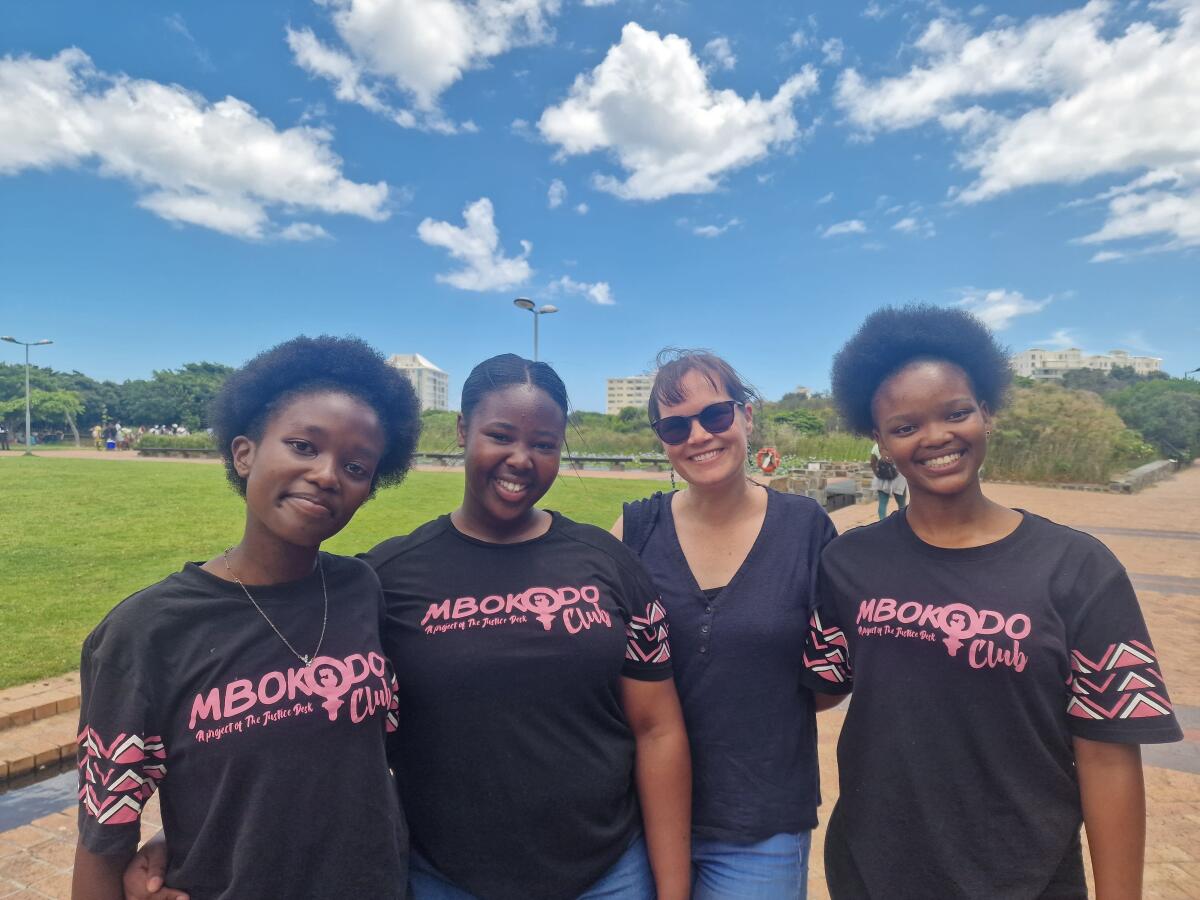
The Mbokodo Programme supports girls who are survivors of gender-based violence (GBV). Their journey includes trauma support, human rights training, leadership development and self-defence classes. Over four years, these girls grow into confident young women who advocate for themselves and others. The iNtsika programme works with boys who are at risk of joining gangs and who often carry their own trauma. They also spend four years in the project, first focusing on healing, then learning about positive masculinity, human rights and community leadership. Staff explained that this age group offers a crucial window where harmful beliefs can be challenged and reshaped. In the third and fourth years, the girls and boys come together to work on advocacy campaigns to tackle human rights violations in their communities.
In response to severe gang violence in the Cape Flats, where 30 people are killed every 72 hours, the project participants drafted and delivered a memorandum of demands to the Ministry of Police, supported by a community protest. The Ministry responded within a week and invited JDA staff and students to a formal meeting. A follow-up meeting with the Western Cape Police Commissioner is now scheduled. Their advocacy has contributed to greater attention, with three political parties requesting that the Cape Flats be declared a national disaster, a proposal currently being discussed in parliament. This is one of many examples of how the project is empowering communities to advocate for their rights and bring about tangible changes.
Protest action is also a central part of JDA’s grassroots approach. While there, I took part in three peaceful demonstrations led by JDA. One march focused on the extremely high rates of femicide in South Africa with an estimated 15 women killed by their partners every day. Another protest called for better vetting of taxi drivers because of the high number of attacks against women using taxis. The final march highlighted the lack of government action on the crisis in the Cape Flats. At each protest, participants handed memorandums of demands to the authorities. JDA sets up committees to monitor progress and keep pressure on the government.
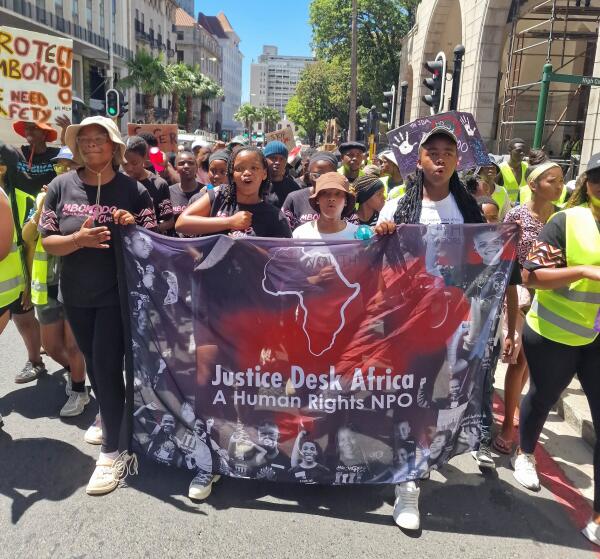
JDA participants protesting the lack of police action against increasing murder rates in the Cape Flats.
Alongside these initiatives is the Youth Ambassadors Programme, which equips young people from across Africa to challenge human rights abuses in their schools and communities. It is active in nine countries and currently involves 57 schools, 96 Advocacy Teachers and around 212 Youth Ambassadors. I was able to attend a Youth Ambassador changemakers workshop where students led sessions on stress, emotions and burnout during exam season. One example of the programme’s impact is 16-year-old Sesona. Staff described her journey from joining the programme to being nominated as Junior Commissioner of Police for her district, to serving in the Western Cape Junior Parliament, the National Child Parliament and eventually representing South Africa at the C20 and G20. This is one of many examples of the impact this programme is having on its participants. Not only do they experience personal growth, but they also work towards helping others in their communities.
I was also deeply impressed by JDA’s commitment to disability inclusion. Through a partnership with the Dominican School for the Deaf, deaf students now participate fully in all activities. An interpreter attends every session, and staff and young people learn sign language so everyone can communicate. In 2025, JDA worked with Deaf South Africa to make a submission to the Department of Education advocating for sign language in schools. The department is now reviewing this with the curriculum unit and treasury, which will hopefully lead to a pilot project starting in 2026. Seeing these young people grow into confident advocates for human rights was inspiring. JDA’s consistent, community-based work is creating real change, and empowering their participants to bring about the change themselves!